
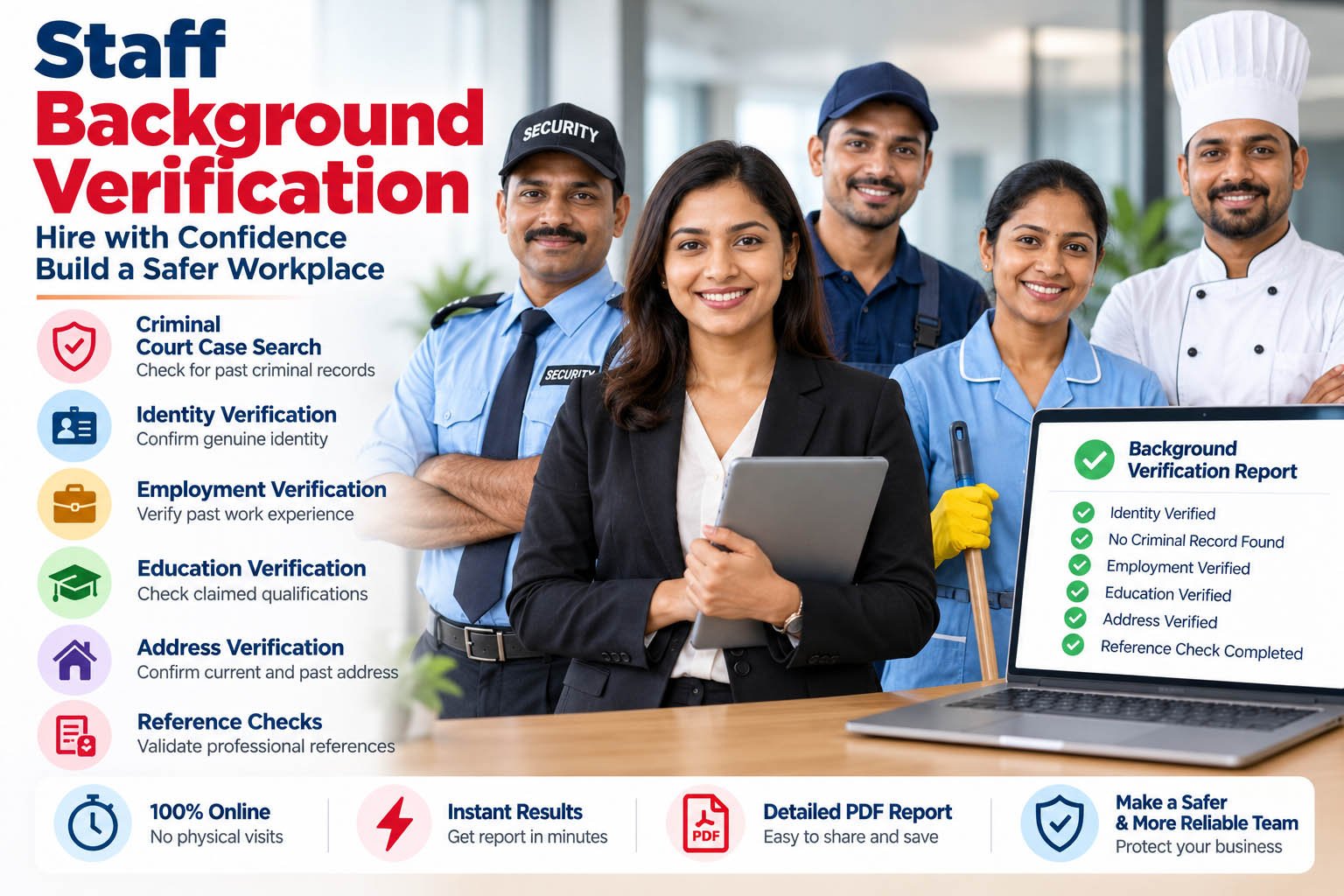
Staff Background Verification in India: The Complete Guide to Safer and Smarter Hiring
Introduction: Why Staff Background Verification Matters
Hiring the right employees is one of the most important decisions a business makes. Employees are entrusted with company resources, confidential information, customer relationships, financial transactions and, in many cases, the safety of other people. Yet, during recruitment, employers often rely heavily on interviews, CVs, references and documents supplied by candidates without independently verifying whether the information is accurate.
A candidate may have an impressive résumé, communicate confidently and perform well during an interview. But are their educational qualifications genuine? Have they accurately represented their previous employment? Is their identity authentic? Have they disclosed relevant information that could affect their suitability for the position?
These questions explain why staff background verification is an essential part of responsible recruitment in India.
Staff background verification, also known as employee background screening or pre-employment background verification, involves checking relevant information about a prospective or existing employee before making or continuing an employment decision.
Depending on the role, industry and applicable legal requirements, the process may include identity verification, criminal court case searches, employment history verification, educational qualification checks, address verification and professional reference checks.
For employers, the objective is straightforward: make informed hiring decisions using reliable information rather than relying exclusively on claims made during recruitment.
Whether you operate a small business, retail outlet, manufacturing unit, school, hospital, financial services company or large corporate organisation, a structured employee verification process can help strengthen workplace safety, reduce recruitment risks and protect your business reputation.
What Is Staff Background Verification?
Staff background verification is the process of independently assessing information supplied by a job applicant or employee to establish whether relevant details are accurate and consistent.
The scope of verification depends on the employee’s responsibilities, the level of access they will receive, the nature of the organisation and the checks permitted by applicable law.
A typical employee background check may include:
- Identity verification to confirm personal details.
- Criminal court case searches using relevant available records.
- Employment verification to confirm previous work experience.
- Education verification to validate qualifications.
- Address verification to assess declared address details.
- Professional licence and registration checks, where applicable.
- Reference checks to obtain relevant professional information.
Not every employee requires every type of check. Employers should establish a screening policy that reflects the actual responsibilities and risks associated with each position.
The process should also respect candidates’ privacy, use appropriate legal grounds for processing personal information and provide a fair opportunity to clarify discrepancies.
Why Is Employee Background Verification Important?
1. Detect False Information in CVs and Résumés
Recruiters frequently receive applications containing claims about academic qualifications, professional experience, previous employers and specialist skills.
Although many candidates provide accurate information, some applications may contain exaggerated or incorrect details.
Employment and education verification can help identify discrepancies such as:
- Degrees or diplomas that cannot be authenticated.
- Employment dates that differ from the candidate’s claims.
- Incorrect job titles or responsibilities.
- Unsubstantiated professional certifications.
- Material inconsistencies between the CV and supporting documents.
Such discrepancies do not automatically prove deliberate fraud. Candidates may make mistakes, and records may be incomplete. Employers should investigate material inconsistencies before reaching a conclusion.
Independent verification helps recruiters distinguish documented facts from unconfirmed claims.
2. Protect Company Assets and Confidential Information
Employees may have access to customer databases, financial systems, intellectual property, business strategies, inventory and sensitive commercial information.
For positions involving significant financial authority, privileged system access or confidential information, suitable background screening can form part of an organisation’s risk management framework.
For example, a company recruiting a finance manager may reasonably place greater emphasis on employment history, qualifications and role-relevant checks than it would for a short-term position with limited access.
Screening should be proportionate and consistent with applicable law. A background check is not a guarantee against future misconduct, but it can provide useful information before access is granted.
3. Strengthen Workplace Safety
Employers have responsibilities towards their employees, customers, visitors and other people affected by their operations.
Certain roles involve direct responsibility for vulnerable individuals, access to private homes or close contact with children and elderly people. In such situations, appropriate screening can be particularly important.
For example, organisations hiring caregivers, nurses, security guards, drivers and childcare workers may need to assess identity, qualifications, professional registration and other role-specific information.
A well-designed verification process should complement supervision, staff training, incident reporting and other workplace safety measures.
4. Reduce Recruitment and Training Costs
Hiring an unsuitable candidate can create substantial costs through recruitment fees, onboarding, training, lost productivity and repeated hiring.
If a candidate’s claimed qualifications or employment history are materially inaccurate, discovering the discrepancy before appointment may help an employer avoid unnecessary expenditure.
Online background verification can streamline selected checks and reduce administrative work, particularly for businesses recruiting regularly.
However, turnaround times vary. Database-based searches may be completed quickly, while direct confirmation from previous employers, educational institutions or other sources may require additional time.
5. Protect Business Reputation
An organisation’s reputation depends partly on the people representing it.
Employees interact with customers, suppliers, partners and the public. Misrepresentation of qualifications or suitability can create operational, legal and reputational problems.
A consistent employee screening policy demonstrates that recruitment decisions are supported by a defined process rather than assumptions or informal assurances.
This is particularly relevant for organisations in healthcare, education, financial services, security, logistics and customer-facing industries.
6. Support Regulatory and Industry Compliance
Certain roles and sectors may have specific qualification, registration, suitability or verification requirements.
Employers should identify the requirements applicable to their industry, location and employee responsibilities.
Background verification can support compliance processes, but it should not be assumed that a generic online report satisfies every statutory requirement.
Where an official certificate, prescribed police verification or regulator-mandated check is required, employers must follow the applicable procedure.
Types of Staff Background Verification in India
1. Identity Verification
Identity verification helps establish whether the personal information supplied by a candidate is consistent with suitable supporting records.
It may involve checking names, dates of birth and other relevant identity details through lawful verification methods.
Identity verification is important because errors in personal information can affect other checks, including education, employment and court record searches.
Employers should use appropriate methods, protect identity documents and avoid collecting unnecessary personal information.
2. Criminal Court Case Search
A criminal court case search can identify potentially relevant court records available within the search’s stated scope.
For certain positions, this information may help an employer assess role-related risks, subject to applicable law and fair recruitment practices.
However, employers must understand an important distinction: the existence of a court case does not automatically establish that a person is guilty of an offence.
Pending cases, convictions, acquittals and disposed proceedings have different legal meanings. Court records may also contain individuals with similar names, and database coverage may be incomplete.
A responsible screening process should verify identity matches, examine the status and nature of relevant proceedings and provide an opportunity for clarification where appropriate.
An online court search is not equivalent to a comprehensive police record or a police clearance certificate.
Employers should not automatically reject applicants based on unverified allegations or an incorrectly matched record.
3. Employment History Verification
Employment verification checks information supplied about a candidate’s previous work experience.
Depending on the source and the information lawfully available, the process may confirm:
- Previous employer names.
- Employment start and end dates.
- Job titles.
- Roles and responsibilities, where confirmable.
- Other relevant employment details.
This is particularly useful when recruiting experienced professionals, managers, technical specialists and employees who will hold positions of trust.
If a discrepancy is identified, employers should investigate it fairly. Differences in job titles or employment dates may have legitimate explanations.
4. Education Qualification Verification
Educational qualification verification helps establish whether a candidate’s claimed degree, diploma or certification can be confirmed.
This can be particularly important when qualifications are essential for the position or required by applicable regulations.
Employers may verify qualifications through the issuing institution or an authorised verification source, subject to the institution’s procedures.
Relevant checks may include degree authenticity, course completion and professional qualifications.
Where a qualification is mandatory, employers should establish that the candidate meets the applicable requirements before making a final appointment.
5. Address Verification
Address verification helps assess whether the address details provided by a candidate are consistent with available supporting information.
The process may involve document-based checks or other lawful methods, depending on the service used.
Address verification can support employee record management, emergency contact administration and other legitimate business requirements.
An address that cannot be confirmed through one method should not automatically be treated as evidence of dishonesty. Candidates may have recently moved or may not possess conventional address documentation.
6. Professional Licence and Registration Checks
Some employees must hold valid licences, registrations or professional credentials to perform their duties.
Examples include certain healthcare professionals, drivers and other regulated occupations.
Employers should check the relevant issuing authority or authorised source wherever possible.
For these positions, verifying the validity of a required licence or registration can be as important as checking employment history.
7. Reference Verification
Professional references may provide additional context about a candidate’s previous work, responsibilities and professional conduct.
Employers should seek relevant references through appropriate channels and avoid treating an unverified personal opinion as established fact.
Reference checks are most useful when they supplement other reliable information rather than replace objective verification.
Which Employees Should Undergo Background Verification?
Background screening should be designed around the responsibilities and risks of the position.
Corporate and Office Employees
Identity, employment history and educational qualification checks may be appropriate, with additional screening for roles involving confidential information or financial authority.
Finance and Accounting Staff
Employers may place greater emphasis on relevant qualifications, employment history, identity and role-specific checks because these employees may handle financial transactions or sensitive records.
Security Guards and Facility Management Staff
Identity, employment and appropriate criminal court record searches can form part of a broader safety process, subject to applicable law and the requirements of the role.
Drivers and Logistics Employees
Employers should verify identity, relevant driving licence validity, employment history and other appropriate information. Licence checks should use suitable official or authorised channels where available.
Healthcare and Caregiving Personnel
Qualification and professional registration checks are important where required. Additional screening should reflect the employee’s responsibilities and level of contact with patients or vulnerable people.
School, Nursery and Childcare Staff
Institutions should apply safeguarding-focused screening that reflects the employee’s access to children and applicable education and child protection requirements.
Domestic Staff and Household Employees
Households employing cooks, drivers, nannies,