
Instant Online Background Verification Before Marriage in India: Why It Beats Hiring a Detective
Key takeaways
- Matrimonial background verification confirms who a prospective bride or groom really is, covering identity, education, employment, address and court records, before two families commit to a wedding.
- The risk is current. Recent police and court cases involve fake “ISRO scientists”, fake UK-based grooms, “looteri dulhan” gangs and concealed first marriages.
- It matters for arranged and love marriages. In a love match, nobody else is vetting the partner.
- Online checks are faster, cheaper, more consistent and far less open to blackmail than a private detective. They cannot, however, prove marital status on their own or guarantee a “clean” record.
What is matrimonial background verification?
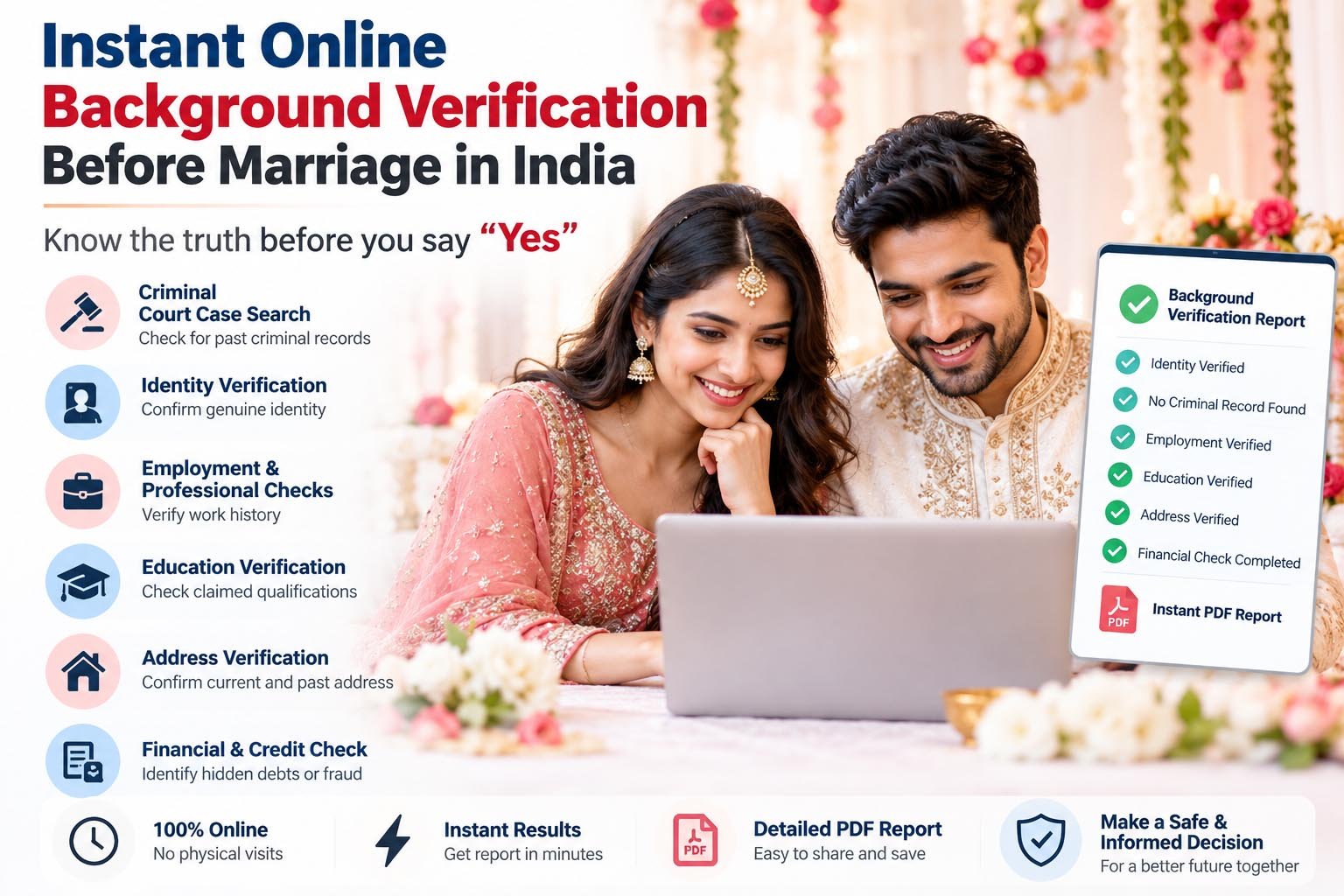
Matrimonial background verification is a consent-based check of a prospective spouse’s claimed identity, education, employment, address and public court records, done before engagement or marriage. Online services run most checks digitally, so results can arrive in minutes to a couple of days rather than weeks.
A typical online report covers:
- Identity: a government ID matched with a live selfie, so the face on the profile is the face on the document.
- Education and employment: confirmation of degrees and employers, which catches inflated qualifications and invented jobs.
- Address: whether the stated home address exists and matches the person’s documents.
- Court and police records: searches of digitised court records for cheating, criminal, matrimonial or domestic-violence cases.
- Marital documents: a divorce decree or death certificate when someone says they are divorced or widowed.
- Digital footprint: whether public profiles tell the same story as the proposal.
How it works. The prospect (or the family) consents, uploads an ID and takes a selfie. The platform validates the documents, runs record searches and compiles a report that marks each check as verified, not verified or not found. Many checks return within minutes; record searches can take a little longer.
Be honest about the limits. India has no single, public, searchable FIR database, and coverage of digitised records varies significantly by state. A “no record found” result lowers risk; it is not a character certificate. Likewise, no registry proves someone is unmarried, so a good report states what was checked and what could not be.
Why does background verification matter before marriage in India?
Because Indian marriages join two families, cost a great deal and are hard to undo, while the people who arrange them are increasingly strangers: brokers, matrimonial websites and distant “NRI” contacts. The old informal vetting no longer works.
- Arranged marriage is still the norm. A widely quoted 2018 survey of 1.6 lakh families found that 93 per cent of participants had arranged marriages.
- The old vetting has weakened. Families once relied on priests, matchmakers and neighbours who knew the other side. That works in a close-knit community. It does not work for a profile from another state, a broker you met once or a groom “settled abroad”.
- The stakes are high. Wedding spending, gifts, jewellery, loans for a “business” and the stigma of a failed marriage fall largely on one family.
- Remedies are slow and complicated. In 2026 the Madras High Court held that a woman who marries without knowing of the man’s existing marriage cannot be prosecuted for bigamy, and noted a March 2026 Calcutta High Court ruling that the offence of concealing an earlier marriage is non-cognisable.
- The numbers are moving. Mumbai police data shows cases of sex obtained through deceit, including false promises of marriage, rose from 126 to 179 in the first half of 2026.
What goes wrong without verification? Recent cases from the news
These are allegations reported by police and media. Accused persons are presumed innocent until proven guilty, and we have left out names. The pattern repeats: a flattering profile, a plausible story, then urgency, secrecy or a request for money.
Fake profiles and fake matchmakers
- Pune, April 2026: Police arrested a 34-year-old who allegedly posed as an ISRO scientist on a matrimonial site, used several aliases and persuaded a woman to take loans, cheating her of ₹26.5 lakh. An employer and identity check would have tested the ISRO claim at the first step.
- Bhiwandi, June 2026: A woman allegedly lost ₹9.17 lakh in 41 transfers to fraudsters posing as a UK-based groom, who claimed he had been detained at an airport and needed urgent money. A live-video identity check can expose a fake persona before money moves.
- Pune, February 2026: A 44-year-old woman allegedly sent ₹59.37 lakh over about 18 months to a man she met on a matrimonial website; the report notes she acted without verifying his identity or background.
- Pune and Perth, June 2025: Police say one man used a single invented “doctor” profile to message 3,194 women on a matrimonial site. One woman lost ₹3.6 crore.
- Delhi, September 2026: Police busted a fake matchmaking service run from an Agra call centre that allegedly capped each fraud at ₹15,000 to discourage complaints. Verify the matchmaker, not just the match.
Fake brides and broker-led weddings
- Kota, July 2026: Police arrested eight members of an interstate “Looteri Dulhan” syndicate. Brokers allegedly took ₹1–2 lakh to introduce brides who were already married and who vanished within days with cash and jewellery.
- Beed, May 2026: Police are investigating a suspected “looter bride” racket in which one woman allegedly married nine grooms and fled each time with valuables.
ID with a live face match, marital-status documents and a check on the broker can expose these patterns before the wedding.
Hidden marriages and relationships
- Allahabad High Court, February 2026: The court refused to quash proceedings under Section 69 of the Bharatiya Nyaya Sanhita, where the FIR alleged a false promise of marriage and concealed marital status.
- Kerala High Court: Hiding a live-in relationship and a child from a prospective bride prima facie attracts the same section, the court held.
- Pune: Police arrested a man accused of hiding his first marriage during a relationship that allegedly ran from 2021 to 2024.
NRI grooms who disappear
- In Haryana’s Karnal district alone, police registered around 55 cases of NRI husbands abandoning wives over five years and issued 60 look-out circulars.
- India’s government received 6,094 complaints between 2015 and October 2019 from women duped into marriages with NRI men.
Checking passport and visa status, the overseas employer and marital-status declarations before the wedding can prevent this.
Do love marriages need background verification too?
Yes. In arranged marriages, families at least attempt some vetting. In love marriages nobody does, and the relationship runs entirely on what one person tells the other, which is why open, mutual verification protects both partners.
Dating apps, Instagram and workplace romances make it easy to present a curated life: a job, a marital status, a past. Private investigators told The Nod that clients now request checks even while dating, sometimes without involving their families, because deception on dating apps is so easy. Several cases above, including the Allahabad and Pune matters, began as relationships rather than family-arranged proposals.
Men are targets too: the Delhi and Kota cases above both involved men seeking marriage.
For love marriages, verification works best as an open, mutual step: “let’s both verify before we announce.” It protects both partners and avoids the damage that covert investigation does to trust. For arranged marriages, families can run checks quietly but should still tell the other side. Transparent verification signals seriousness, not suspicion.
Online background verification vs private detective: time, cost, accuracy and blackmail risk
Online verification wins on speed, cost, consistency and privacy risk: digital checks take minutes to a couple of days, cost a fraction of a detective’s fee, follow a standard method and leave no sensitive surveillance material in unlicensed hands. Detectives still add value for complex, on-the-ground investigations.
| Factor | Instant online verification | Private detective |
|---|---|---|
| Time | 2Minutes for digital identity checks, court case checks, employment checks | 10 days to six months |
| Cost | A fraction of a detective’s fee, priced per check | ₹25,000 to ₹25 lakh |
| Accuracy | Document- and record-based; same checks, same format every time | Varies by individual; findings can be hearsay |
| Regulation | consent-based and handled under India’s data-protection law | No licensing regime |
| Blackmail and legal exposure | Low: no surveillance, recordings or photographs | Real: sensitive material held by an unlicensed third party |
Time. A family that has fixed a muhurat cannot wait months. Detective investigations run from 10 days to six months, depending on scope. Digital checks run in minutes (identity, face match) or a day or two (record searches), so you can verify before the engagement, not after the invitations are printed.
Money. The Nod reports detective fees from ₹25,000 to ₹25 lakh, and an AFP report put them at roughly US$100 to US$2,000 depending on the surveillance needed. One dossier in The Nod’s reporting cost ₹6 lakh and six weeks. A per-check online report costs a fraction of that, which means you can verify every shortlisted prospect instead of just one.
Accuracy. Detective quality varies with the individual. The ₹6 lakh dossier above was, by the author’s own description, circumstantial and hearsay. Online verification relies on documents, databases and records, applies the same checks to every prospect and produces an auditable report. It is not infallible (see the limits above), but it separates “verified” from “unverified” instead of mixing rumour with fact.
Blackmail and legal risk. This is the factor families discuss least. Detective work generates sensitive material: photographs, recordings, family secrets. The profession has no licensing regime, and a 2007 bill to regulate it had still not been enacted as of March 2026. The Nod also profiles an anonymous operator who employs hackers and stages entrapment. Police have repeatedly busted rackets in which detective agencies bought confidential call records illegally: in 2016, Delhi Police found agencies procuring them for clients in matrimonial and other disputes at ₹5,000–₹30,000 a record, and a 2022 probe found the records mostly related to matrimonial disputes. The trade has not gone away: on 10 October 2026, Mumbai Crime Branch arrested nine people, including two police personnel, over a call-record and location-data racket.
Most detectives do not blackmail clients. But when a third party holds your family’s secrets, with no licence to lose and no regulator to answer to, you carry that risk, and illegally obtained material can expose you legally too. Consent-based online verification has no such leverage: the prospect knows it is happening, the scope is defined, and nobody follows anyone or records anything.
When a detective still makes sense. Suspected hidden families overseas, litigation-grade evidence and on-the-ground inquiries that a database cannot answer. Even then, start with an online check and brief the detective with verified facts.
How to verify a prospective spouse: a 7-step checklist
Use this sequence whether the match came from family, a broker, a matrimonial site or an app.
- Get consent and be transparent. Tell the other side you are verifying, and offer to be verified too.
- Verify identity. Match a government ID like Aadhaar or Passport. Mismatched names or photos are the first red flag.
- Verify education and employment. Confirm the degree and employer at the source, not through documents the prospect supplies.
- Run a court and police-record search. Treat results fairly: an FIR is not a conviction, and a pending case is not a verdict.
- Verify NRI details. we confirm passport and visa status before gold, cash or commitments change hands.
- Never send money first. No “customs fees”, “processing charges” or loan requests before you have met and verified. If you have been targeted, report it on the 1930 helpline or at cybercrime.gov.in.
What are the legal and ethical limits?
Verification should be consent-based, proportionate and fair. Use only lawfully obtained information; never buy phone records or track someone’s movements. India’s DPDP Act, 2023 is built around consent and a defined purpose for processing personal data. A pending case or FIR should start a conversation, not trigger automatic rejection. This article is general information, not legal advice.
Frequently asked questions
Is background verification before marriage legal in India? Yes, when it checks identity, education, employment and public court records with the prospect’s knowledge and consent. What is unlawful is obtaining private data by illegal means, such as call-detail records, or stalking and surveillance.
How long does online matrimonial verification take? Digital identity and Court and police-record searches usually take 2 minutes on our platform. Detective investigations commonly take 10 days to six months.
Do love marriages need background verification? Yes. Without family vetting, a partner’s claims about job, marital status and past go unchecked. Open, mutual verification protects both people.
What if the report shows an FIR or pending case? Read the details before reacting. An FIR is an allegation, not a conviction. Ask the person to explain, request the court documents and consult a lawyer if the matter involves cheating, violence or an earlier marriage.
How can I spot a fake matrimonial profile? Warning signs include a glamorous overseas or government job that cannot be confirmed, a refusal to video-call, urgent requests for money, pressure to move to WhatsApp quickly, and photos that appear elsewhere online. Check their background on our platform before you trust.
The bottom line
Marriage is too important to run on a profile, a broker’s word or an unlicensed stranger’s dossier. An online check takes minutes, costs a fraction of a detective’s fee and leaves nobody holding your family’s secrets. Verify first, then celebrate.
Start a matrimonial background verification at Checkk