
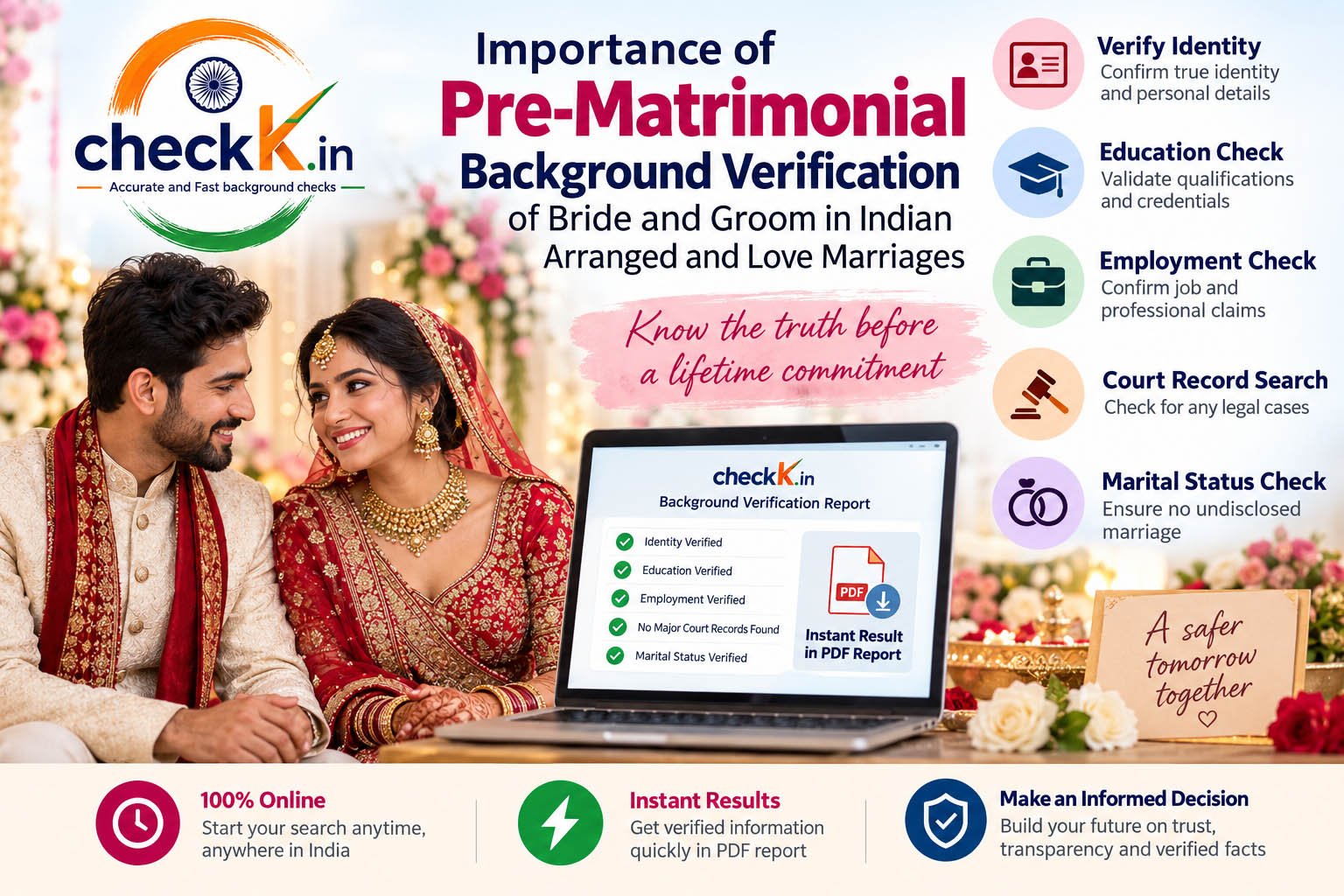
Importance of Pre-Matrimonial Background Verification of Bride and Groom in Indian Arranged and Love Marriages
Introduction: Building a Marriage on Trust, Transparency and Verified Information
Marriage is one of the most significant decisions in a person’s life. In India, whether a marriage is arranged by families or develops through a romantic relationship, the decision to marry often involves emotional commitment, family expectations, financial considerations and long-term responsibilities. While compatibility, love and mutual respect are essential for a successful marriage, there is another important factor that should never be overlooked: knowing the person you are planning to marry.
In today’s rapidly changing social environment, it is increasingly important for both the bride and groom to make informed decisions before marriage. A person’s public image, social media presence, professional claims and personal assurances may not always provide a complete picture of their background. Important information concerning marital status, employment, education, financial circumstances or past legal issues may remain undisclosed until after the wedding.
Pre-matrimonial background verification helps individuals and families make informed marriage decisions by checking relevant information before making a lifelong commitment.
Whether you are a parent searching for a suitable match for your daughter, a family evaluating a prospective groom, a bride who wants to understand her future husband’s background, or a man considering marriage to someone he has met through a matrimonial platform, responsible verification can help establish greater confidence.
With online verification services such as Checkk.in, individuals can initiate selected background checks conveniently and receive results quickly, depending on the verification service and the availability of records.
This article explains why pre-matrimonial background verification matters in both arranged and love marriages, what information may be worth checking, and how online verification can support a more informed decision.
1. Why Is Pre-Matrimonial Background Verification Important in India?
Indian marriages frequently involve more than two individuals. Families, financial interests, social relationships, future children and long-term commitments can all be affected by the decision.
Traditionally, families have relied on relatives, neighbours, community networks and mutual acquaintances to learn about a prospective bride or groom. These sources can be useful, but they may not always provide complete, current or independently verified information.
Modern relationships have also expanded beyond traditional social circles. Matrimonial websites, dating applications, social media and professional networking platforms allow people to meet prospective partners from different cities, states and countries.
Although these platforms create opportunities for meaningful relationships, they can also make it more difficult to independently establish whether every claim made by a prospective partner is accurate.
Pre-matrimonial verification can help address several important questions:
- Is the person’s claimed identity consistent with the available records?
- Are their educational and professional claims supported by verifiable information?
- Is there any relevant information about an existing marriage that needs clarification?
- Are there publicly accessible legal records that warrant further investigation?
- Are important claims about their personal or professional circumstances inconsistent?
- Can both individuals make their marriage decision with greater confidence?
Verification is not about treating every prospective partner with suspicion. It is about recognising that trust and due diligence can coexist.
A healthy relationship should allow both people to discuss reasonable questions, respect each other’s privacy and make important decisions with transparency.
2. Pre-Matrimonial Verification in Arranged Marriages
Arranged marriages remain an important part of Indian society. Families may introduce prospective partners through relatives, community networks, matrimonial agencies or online matrimonial platforms.
In many cases, the families meet only a few times before deciding whether to proceed. Even when both families are respectable and well-intentioned, the information available about a prospective bride or groom may be based primarily on statements made during introductions.
This can create gaps between what is claimed and what can actually be established.
2.1 Verifying the Groom’s Background
When a family evaluates a prospective groom, they may consider his employment, education, income, family circumstances and future plans.
However, a professional designation, an impressive salary claim or an overseas employment opportunity should not automatically be treated as proof of the underlying facts.
Depending on the circumstances, a family may consider:
- Identity verification: Establishing consistency between the person’s claimed identity and appropriate supporting records.
- Employment verification: Checking relevant employment claims through legitimate sources or authorised verification procedures.
- Education verification: Confirming educational qualifications through institutions or recognised verification channels where available.
- Court record searches: Identifying potentially relevant publicly accessible court records, subject to the limitations of the databases searched.
- Marital status enquiries: Seeking reliable evidence and clarification about whether the individual has a current or previous marriage that has not been disclosed.
- Address verification: Checking a declared address through lawful and appropriate methods, where such a service is available.
These checks may be particularly relevant when a prospective groom claims to hold a senior position, operate a business, work overseas or possess qualifications that significantly influence the marriage decision.
For example, a prospective groom may describe himself as a senior executive working abroad. If employment and education are major considerations for the family, independently checking those claims can help distinguish verified information from unconfirmed statements.
2.2 Verifying the Bride’s Background
Pre-matrimonial verification should not be limited to men. A prospective groom has an equally legitimate interest in understanding relevant information about the woman he intends to marry.
A woman’s identity, educational qualifications, employment claims and relevant publicly available legal records may be checked using lawful, proportionate methods.
For example, a prospective bride may describe herself as holding a particular professional qualification or working for a specified organisation. If that information is important to the marriage decision, it may be appropriate to verify it with her knowledge and through legitimate channels.
The same principles of transparency and fairness must apply to both the bride and the groom.
Verification should never become an excuse for gender-based discrimination, intrusive surveillance or attempts to control a partner’s personal life. Its purpose is to establish relevant facts, not to judge someone’s worth based on gender, income, family background or personal history.
2.3 Why Family Reputation Alone Is Not Enough
A family’s reputation can provide useful context, but it cannot independently establish every detail about an individual family member.
People may have different financial circumstances, personal histories and professional experiences from those of their relatives. Similarly, a well-regarded family may simply be unaware of certain facts about a prospective bride or groom.
Responsible verification therefore focuses on the individual and the specific claims relevant to the proposed marriage rather than assuming that family reputation guarantees accuracy.
3. Why Pre-Matrimonial Verification Matters in Love Marriages
Love marriages often begin with emotional connection, shared interests and time spent together. Partners may communicate daily and feel that they know each other deeply before deciding to marry.
Nevertheless, emotional intimacy does not automatically mean that every important fact has been independently established.
People may meet through friends, workplaces, dating applications, social media or travel. Some relationships develop over long periods, while others progress towards marriage relatively quickly.
In either situation, it is reasonable for both partners to discuss and verify important information before making a long-term commitment.
3.1 Online Relationships and Identity Concerns
Online communication can make it easier to connect with people outside one’s immediate social circle. It can also make it difficult to distinguish between a genuine identity and a misleading online presentation.
A person may use outdated photographs, provide inconsistent personal details or misrepresent their occupation or circumstances.
Before marriage, partners should consider whether the identity and important background claims of the person they intend to marry are consistent with reliable information.
Identity verification, where available and lawfully performed, may help address some of these concerns. It cannot, however, guarantee that every aspect of a person’s identity or personal history is genuine.
3.2 Discovering Undisclosed Marital Commitments
One of the most consequential issues in a prospective marriage is whether either person has an existing marriage or another relevant marital circumstance that has not been disclosed.
A previous marriage, separation or divorce may require an honest discussion and, where relevant, examination of appropriate supporting documents.
An existing marriage that has not legally ended can create serious personal and legal complications. The legal implications depend on the applicable personal law and circumstances.
Neither partner should assume that a person’s relationship status on social media or a verbal assurance provides conclusive proof of their legal marital status.
Appropriate questions, transparent discussions and reliable documentary evidence can help establish a clearer picture before the wedding.
3.3 Discussing Employment, Income and Financial Responsibilities
Financial transparency is an important part of preparing for married life.
Partners should discuss employment, income expectations, existing financial commitments, dependants, debts and plans for managing household expenses.
Where relevant, employment claims and other material representations may be verified through lawful means with appropriate consent.
It is important to distinguish between a person’s financial worth and the accuracy of their statements. A person does not need to be wealthy to be a suitable marriage partner. However, knowingly misrepresenting important financial circumstances can undermine trust and prevent a couple from making informed decisions.
3.4 Addressing Serious Concerns Without Undermining Trust
Some people hesitate to suggest verification because they fear it may appear insulting or imply a lack of love.
However, the issue can be approached as a mutual process rather than a one-sided investigation.
For example, partners can agree to verify material claims about identity, qualifications and other relevant matters together. Both can ask questions, explain their concerns and establish boundaries around sensitive personal information.
A mature relationship should make room for honest conversations about matters that could materially affect the future marriage.
Verification does not replace communication, compatibility or emotional understanding. It complements them by helping partners make decisions based on more than assumptions.
4. What Are the Risks of Skipping Pre-Matrimonial Verification?
Not every marriage without formal background checks encounters difficulties. Many couples build successful marriages through open communication, mutual understanding and responsible family involvement.
However, skipping reasonable checks when significant claims or warning signs exist may expose individuals to avoidable risks.
4.1 Misrepresentation of Personal Details
False or materially misleading information about identity, education, employment or other important circumstances can affect a marriage decision.
The consequences may include emotional distress, family conflict, financial loss and difficulty resolving the relationship after the marriage.
Verifying relevant claims before the wedding may help identify inconsistencies early enough for the parties to discuss them.
4.2 Undisclosed Legal Issues
Publicly accessible court records may reveal proceedings relevant to a prospective partner. Depending on the case, these records may warrant clarification before marriage.
However, a court case is not proof of guilt. A person may be a complainant, witness, respondent or accused, and the case may be pending, dismissed, withdrawn or concluded in their favour.
Any finding must be interpreted carefully, with attention to the person’s role, the nature of the proceedings and the current status of the case.
A responsible verification process should never equate an allegation with a conviction or treat every legal dispute as evidence of misconduct.
4.3 Financial Misrepresentation and Fraud
Marriage may involve shared financial decisions, property purchases, household expenditure and long-term planning.
Materially false claims about employment, business ownership, income or financial circumstances can create serious difficulties.
Verification of selected claims may help reduce uncertainty, but no background check can eliminate every financial risk. Partners should also discuss financial expectations openly and seek appropriate professional advice when substantial assets or complex financial arrangements are involved.
4.4 Emotional and Family Consequences
Discovering an important undisclosed fact after marriage can create feelings of betrayal and may affect relationships between both families.
The practical and emotional consequences can be significant, particularly when major commitments have already been made.
Pre-matrimonial verification cannot guarantee a successful marriage. It can, however, give individuals an opportunity to clarify relevant concerns before making an irreversible or difficult-to-reverse commitment.
5. Important Areas to Consider Before Marriage
The appropriate checks depend on the individual’s circumstances, the information that needs confirmation and the services lawfully available.
| Verification area | Why it may matter |
|---|---|
| Identity details | Helps establish consistency in the person’s claimed identity. |
| Education and qualifications | Helps assess whether material educational claims can be substantiated. |
| Employment details | Helps confirm relevant professional representations. |
| Public court records | May identify legal proceedings requiring further examination. |
| Marital status documentation | Helps clarify relevant previous or existing marital circumstances. |
| Address details | May help establish consistency with a declared residential address. |
| Financial representations | May warrant independent documentary checks where relevant. |
Not every check is appropriate in every case. Some information requires the individual’s cooperation, formal authorisation or access to an official source. Other information may not be available through an online database at all.
For example, a search of publicly accessible court records cannot establish that a person has never been involved in any legal proceeding. Similarly, an online search cannot independently prove that someone is unmarried, financially reliable or truthful in every aspect of their life.
The objective should be to choose proportionate checks that address genuine questions rather than collect as much personal information as possible.
6. How Checkk.in Can Help With Pre-Matrimonial Background Verification
Online verification services can make selected background checks more accessible by allowing users to initiate searches through a digital platform instead of navigating every source independently.
Checkk.in can be considered for relevant verification services offered through its platform, including searches of available court records where supported.
For individuals preparing for marriage, such a service may provide a convenient starting point for checking selected information and identifying matters that need further investigation.
6.1 Convenient Online Access
Families and prospective partners may be located in different cities or states. Arranging every preliminary enquiry in person can be time-consuming.
An online service allows users to initiate supported checks from a convenient location, subject to the platform’s requirements and applicable permissions.
This can be particularly useful when the prospective bride and groom live in different parts of India or when the marriage is being arranged through an online matrimonial platform.
6.2 Quick Results for Supported Searches
Time can be an important consideration when a wedding date is approaching or families are evaluating several potential matches.
Checkk.in promotes online background verification, with results available quickly for supported searches. Actual turnaround times depend on the specific service, source availability, data quality and any additional verification required.
An instant search result should not be confused with a complete investigation. Automated database searches can identify potentially relevant records, but complex cases may require manual review, official documents or further enquiries.
6.3 Access to Relevant Court Record Searches
Where the platform offers a suitable court-record search, it may help users identify publicly accessible legal records associated with the search criteria provided.
Such information may be relevant when deciding whether further clarification or professional advice is necessary before marriage.
Court-record searches have important limitations. Records can contain people with similar names, incomplete identifiers or outdated case information. A potential match must therefore be checked carefully before drawing conclusions.
A responsible user should confirm the person’s identity, examine the case details and determine the person’s role and the current status of the proceedings.
6.4 A More Informed Decision-Making Process
The purpose of using Checkk.in should be to obtain relevant information that supports a thoughtful marriage decision.
For example, if a search identifies a potentially relevant court record, the next step may be to examine the case details, obtain reliable documentation or seek legal advice where appropriate.
If a qualification or employment claim cannot be confirmed through the available search, that does not automatically mean the claim is false. It may simply mean that additional evidence is required.
Verification results should be treated as one part of the decision-making process, alongside direct conversations, mutual consent, compatibility and reliable documents.
6.5 A Practical Starting Point for Families and Individuals
Parents, prospective brides and prospective grooms may not know where to begin when checking important background information.
An online platform can help simplify the initial process for the checks it supports. Users should review the specific services available on Checkk.in, understand what each search covers and confirm whether the result meets their requirements.
For more complex matters, additional independent verification may still be necessary.
The value of a verification service lies in helping users obtain relevant information more efficiently, not in promising certainty about a person’s entire background.
7. Why Both the Bride and Groom Should Participate in Verification
Pre-matrimonial verification is most constructive when it follows the same principles for both partners.
Historically, some families have placed greater scrutiny on a prospective bride’s personal history while focusing on the prospective groom’s income, occupation or family status. Such unequal expectations can encourage unfair judgments and undermine mutual respect.
A balanced approach recognises that both individuals are entering the marriage voluntarily and both deserve the opportunity to make an informed decision.
The bride may reasonably want to understand the groom’s professional claims, relevant legal background and marital circumstances. The groom may have similar questions about the bride.
Neither should be expected to disclose irrelevant or deeply private information merely because the other person requests it. Equally, both should be willing to discuss material facts that could affect their ability to enter the marriage honestly and lawfully.
A mutual approach offers several advantages:
- It establishes consistent expectations about transparency.
- It reduces the perception that one partner is being unfairly targeted.
- It encourages open discussion of concerns before the wedding.
- It reinforces the principle that informed consent is essential to marriage.
- It helps both partners understand the difference between verified facts and assumptions.
Verification should support equality, dignity and informed choice—not suspicion, coercion or control.
8. Is Pre-Matrimonial Background Verification Legal in India?
The legality of a particular check depends on the information involved, the method used to obtain it, the purpose of the search and the applicable laws.
Searching lawfully accessible public court records is different from obtaining confidential government information, accessing another person’s private accounts or collecting protected personal data without appropriate authority.
Individuals should use legitimate sources, respect privacy and avoid unauthorised access to personal information. Where a service requires consent, identity documents or other authorisation, its requirements should be followed.
The Digital Personal Data Protection Act, 2023, and other applicable Indian laws may be relevant depending on the data, processing activity, parties involved and provisions in force. The precise legal position should be assessed for the specific circumstances rather than assuming that every type of background check is automatically permitted.
Users should also understand that a background verification report is not a legal certificate of a person’s character, marital eligibility or future conduct.
For serious concerns involving an existing marriage, divorce, criminal proceedings or other legal matters, a qualified Indian lawyer can help interpret the relevant records and explain their legal significance.
9. How to Conduct Pre-Matrimonial Verification Responsibly
A responsible verification process should be proportionate, transparent and focused on material facts.
Step 1: Identify the information that genuinely matters.
Start with specific questions about identity, education, employment, marital circumstances or relevant public legal records. Avoid searching for personal information that has no reasonable connection to the marriage decision.
Step 2: Discuss verification openly.
Where practical and appropriate, explain why a particular check matters and agree on a fair process. Both individuals should understand the purpose and limits of the checks being conducted.
Step 3: Select suitable verification services.
Review the available services on Checkk.in and choose only those that match the questions being addressed. Confirm what information is required, what sources are searched and what the results can establish.
Step 4: Examine results carefully.
Do not make decisions based solely on a name match, an automated flag or an unexplained report. Confirm identity and review relevant supporting information.
Step 5: Give the other person an opportunity to clarify.
Records may be incomplete, outdated or associated with someone else. Ask reasonable questions and allow the person concerned to provide an explanation or documentation.
Step 6: Seek professional advice when necessary.
If the results reveal a serious legal concern, possible fraud or a complex marital-status issue, consult an appropriate professional before reaching a conclusion.
Step 7: Make the final decision together.
Verification is only one element of marriage preparation. Compatibility, values, communication, expectations about family life and mutual respect remain equally important.
10. What Pre-Matrimonial Background Verification Cannot Guarantee
It is important to understand the limitations of any verification service, including online platforms.
A search cannot guarantee that every relevant record will be found. Databases may be incomplete, certain records may not be digitised, and some information may require an official application or direct confirmation from an institution.
A clean search result does not prove that a person has never been involved in a legal dispute or that every statement they make is accurate. Similarly, the presence of a court record does not establish wrongdoing.
Background verification also cannot predict whether a person will be a faithful spouse, a responsible parent or a compatible life partner.
These qualities are better assessed through time, honest conversations, observation of behaviour and a shared understanding of expectations.
The most reliable approach combines appropriate verification with careful judgment and open communication.
11. Frequently Asked Questions
Is background verification necessary before an arranged marriage?
It is not universally mandatory, but proportionate verification may help families and individuals confirm important claims and address material concerns before marriage.
Should I verify my partner in a love marriage?
Partners in love marriages may also benefit from checking material information, especially when important claims have not been independently established. Ideally, the process should be discussed openly and applied fairly to both people.
Can Checkk.in provide instant matrimonial background verification?
Checkk.in offers online background verification services for supported searches. Results may be available quickly, but actual turnaround times and the information returned depend on the service selected and the availability of relevant records. Users should confirm the current scope of the specific service on the platform.
Does a clean court-record search mean the person has no criminal history?
No. A search may cover only certain databases, jurisdictions or records. It should not be interpreted as conclusive proof that no criminal case or conviction exists.
What should I do if a search reveals a court case?
First, confirm that the record belongs to the correct person. Then establish the person’s role in the proceedings, the nature of the case and its current status. Seek legal advice where necessary. Do not assume that an allegation establishes guilt.
Should only the groom’s background be verified?
No. Both partners should have equal opportunities to make informed decisions. Any checks should be relevant, proportionate and respectful of privacy.
Can verification guarantee a successful marriage?
No. Verification can help clarify selected facts, but a successful marriage also depends on compatibility, communication, mutual respect and shared commitment.
Conclusion: Make an Informed Marriage Decision With Confidence
Marriage should be built on trust, respect, honesty and a clear understanding of the person with whom you intend to share your life.
In India’s arranged and love marriage contexts, pre-matrimonial background verification can help bridge the gap between personal assurances and independently supported information. It can help prospective brides, prospective grooms and their families examine important claims, identify questions that require clarification and make decisions with greater awareness.
The objective is not to investigate every aspect of someone’s private life or to treat every prospective partner as a source of risk. It is to confirm relevant information, address legitimate concerns and protect the right of both individuals to make an informed choice.
Before saying yes to a lifelong commitment, take the time to understand the facts that matter.
Checkk.in provides an online starting point for selected background verification services, helping users access supported searches conveniently and obtain results quickly where available. By combining appropriate verification with honest communication and mutual respect, couples can approach marriage with greater clarity and confidence.
Visit Checkk.in to explore the available background verification services and determine which checks are suitable for your requirements.
Because a strong marriage begins not only with trust, but also with honesty, transparency and informed decisions.