
School and Nursery Staff Background Verification in India: Why Every Educational Institution Must Prioritise Child Safety
Introduction: Protecting Children Starts Before Hiring
Schools, nurseries, preschools, daycare centres and other childcare institutions are entrusted with one of society’s greatest responsibilities: protecting children while helping them learn, grow and develop. Parents place enormous trust in teachers, nursery staff, caregivers, school bus drivers, security guards, housekeeping personnel and other employees who interact with their children every day.
However, how can an educational institution be confident that the people it hires are who they claim to be? Are their educational qualifications genuine? Have they disclosed their complete employment history? Are there relevant criminal court records that require further assessment? Is their identity authentic, and do they have the experience and suitability required to work with children?
These questions make school and nursery staff background verification an essential component of responsible recruitment.
A candidate may perform exceptionally well in an interview, provide convincing references and appear perfectly suitable for a role. Yet, an interview alone cannot independently establish a person’s identity, qualifications, employment history or relevant legal background.
Conducting appropriate pre-employment background checks helps schools make informed recruitment decisions, strengthen safeguarding practices, reduce avoidable risks and demonstrate accountability to parents.
In India, where educational institutions employ large numbers of teaching and non-teaching staff, a systematic background verification process is particularly important. From metropolitan schools to small neighbourhood preschools, every institution should have a clear policy for screening employees and contractors who may come into contact with children.
What Is School and Nursery Staff Background Verification?
School and nursery staff background verification is the process of checking the identity, credentials, employment history and other relevant information of prospective or existing employees to assess their suitability for working in an educational or childcare environment.
The scope of verification depends on the position, the institution’s safeguarding policy, applicable legal requirements and the information lawfully available for checking.
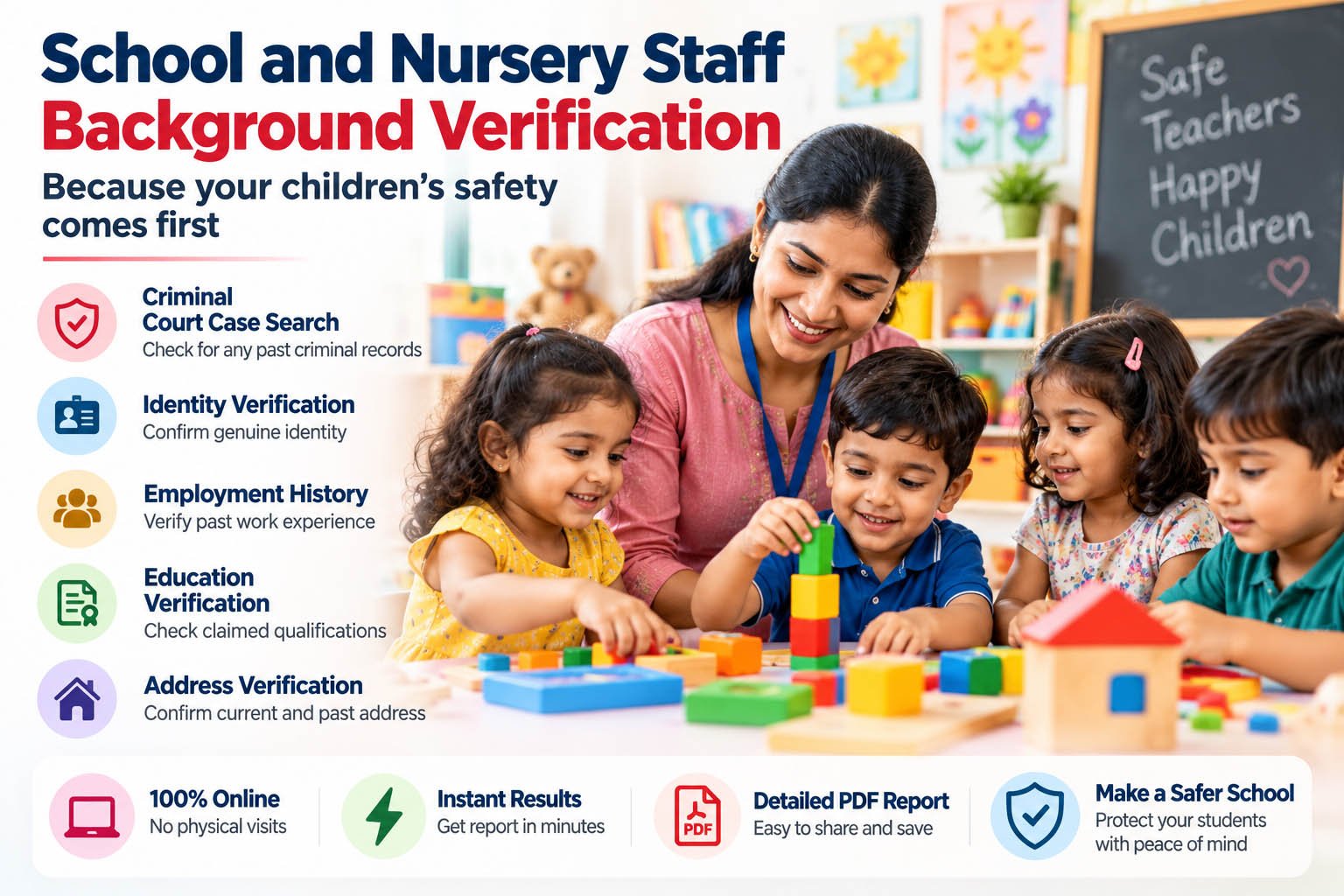
A comprehensive screening programme may include:
- Identity verification.
- Criminal court case searches.
- Employment history verification.
- Educational qualification verification.
- Address verification.
- Professional registration checks, where applicable.
- Reference checks and role-specific screening.
The purpose is not to assume that candidates are untrustworthy. It is to establish a consistent, evidence-based recruitment process that protects children, supports honest applicants and helps institutions identify discrepancies before making hiring decisions.
Why Is Background Verification Important for Schools and Nurseries?
1. Children Depend on Adults for Their Safety
Young children, particularly those attending nurseries, preschools and daycare centres, may not be able to recognise unsafe situations or communicate concerns effectively.
Teachers, assistants, nannies, caretakers and other staff members can have regular access to children during classroom activities, meals, toileting, transportation, playtime and rest periods.
This level of responsibility makes appropriate screening essential.
Without verification, an institution may rely entirely on a candidate’s self-declared information. Where important details have been misrepresented or omitted, the institution could make a recruitment decision without having the information it needs.
Background verification cannot guarantee that misconduct will never occur. However, it can help identify relevant warning signs and form one part of a broader child protection strategy.
2. Prevent Misrepresentation of Identity
Identity verification is a fundamental first step in recruitment.
An applicant may submit identity documents and personal details during the hiring process, but institutions should establish that the information is consistent with the person applying for the position.
Identity checks can help identify discrepancies such as inconsistent names, incorrect dates of birth or documents requiring further examination.
Schools should use lawful verification methods, collect only necessary personal information and follow applicable data protection requirements.
3. Check Criminal Court Records Where Lawfully Available
One of the most important elements of a safeguarding-focused recruitment process is an appropriate criminal court case search.
Such searches may help identify publicly accessible court records associated with a candidate, subject to the accuracy of the information, availability of records and limitations of the search process.
However, a criminal court case search is not the same as a police clearance certificate or a comprehensive criminal history check.
A pending case is not a conviction, and the existence of a case does not automatically establish guilt. Names may also match multiple individuals, making identity matching and careful review essential.
Educational institutions should assess any relevant findings fairly, verify the identity of the individual concerned, consider the nature and status of the proceedings, and seek appropriate legal advice when necessary.
The objective should be to assess role-related safeguarding risks responsibly rather than reject candidates automatically based on an unverified search result.
4. Verify Educational Qualifications and Teaching Credentials
A teacher’s qualifications can directly affect the quality of education and the institution’s regulatory compliance.
Recruiters should verify relevant degrees, diplomas, certificates and professional registrations where required.
For example, depending on the position, a school may need to assess whether a teacher holds the qualifications prescribed for the role and whether applicable Teacher Eligibility Test requirements have been met.
Nursery and preschool institutions should also verify early childhood education qualifications where these are required by their recruitment standards or applicable regulations.
Qualification verification can help identify:
- Fabricated educational certificates.
- Incorrect claims about degrees or diplomas.
- Unverified professional credentials.
- Inconsistencies between applications and supporting documents.
Where possible, institutions should confirm qualifications directly with the issuing educational institution or an authorised verification source.
5. Confirm Previous Employment History
Employment verification helps schools understand a candidate’s professional background and determine whether the experience claimed is genuine.
A candidate may state that they have several years of teaching experience, have worked in multiple reputed schools or have extensive childcare experience.
These claims should be assessed through appropriate checks.
Employment verification may establish previous employers, job titles, employment dates and other relevant details, subject to consent, availability and lawful access.
It may also reveal unexplained gaps or inconsistencies that warrant clarification.
A gap in employment is not, by itself, evidence of wrongdoing. Recruiters should give candidates an opportunity to explain discrepancies and evaluate the information objectively.
6. Verify Address Details
Address verification can help establish whether the address supplied by an applicant is consistent with available supporting information.
Depending on the role and the verification method, this may involve document-based checks or other lawful means of confirming address information.
Address verification can be particularly useful for maintaining accurate employee records, establishing contact information and supporting internal administrative processes.
However, institutions should not treat an inability to verify an address through one particular method as proof of dishonesty. Genuine applicants may have recently relocated or may lack conventional address documentation.
Which School and Nursery Staff Should Be Verified?
Background verification should not be limited to permanent teachers.
A school’s safeguarding policy should consider the nature, frequency and level of access that different workers have to children.
Teaching Staff
Teachers, assistant teachers, subject specialists and special educators may have regular direct contact with students.
Verification should generally cover identity, qualifications, relevant employment history and other checks appropriate to the position.
Nursery and Preschool Caregivers
Nursery workers, childcare assistants, early childhood educators and daycare caregivers may be responsible for very young children who require close supervision.
Their roles can involve feeding, changing, supervising sleep and managing children’s personal care. Appropriate screening should therefore be a priority.
School Bus Drivers and Transport Staff
Drivers and transport assistants may supervise children during daily journeys and school excursions.
Depending on the role, screening should include identity, relevant driving licence validity, driving-related eligibility and other appropriate background checks.
A driving licence should be checked through an authorised source where available rather than accepted solely on the basis of a photocopy.
Housekeeping and Maintenance Personnel
Housekeeping staff, maintenance workers and other support employees may enter classrooms, corridors, washrooms, storage areas and other parts of the campus.
Schools should assess the access these employees have to children and apply suitable screening and supervision procedures.
Security Guards and Reception Staff
Security personnel, receptionists and administrative staff may manage visitor entry, student handovers and access to sensitive areas.
Identity and employment checks, along with role-appropriate background screening, can help strengthen campus security procedures.
Contractual, Temporary and Outsourced Workers
Institutions should also consider staff supplied by agencies, transport operators, catering contractors and facility management companies.
Outsourcing recruitment does not remove the need for effective safeguarding oversight. Schools should clearly define who is responsible for screening, what checks are required and how verification outcomes will be documented.
What Does a Comprehensive School Staff Background Check Include?
A well-designed screening programme uses multiple checks rather than relying on one search alone.
| Verification check | Purpose |
|---|---|
| Identity verification | Establishes consistency between the candidate and the identity details provided. |
| Criminal court case search | Identifies potentially relevant court records available within the search scope. |
| Employment verification | Assesses previous work experience and employment claims. |
| Education verification | Confirms qualifications and relevant credentials. |
| Address verification | Checks the consistency of declared address details. |
| Professional licence checks | Confirms relevant licences or registrations where applicable. |
| Reference checks | Provides additional professional context from suitable references. |
Not every role requires exactly the same checks. Schools should define a proportionate screening package based on the job’s responsibilities, relevant regulations and safeguarding risks.
Is Background Verification Legally Required for School Staff in India?
The legal requirements depend on the institution, the role, the applicable state or local rules and any conditions imposed by the relevant education authority.
There is no single universal rule that should be assumed to impose an identical set of background checks on every employee of every school and nursery across India.
Nevertheless, educational institutions should carefully review applicable requirements, including the following:
Right of Children to Free and Compulsory Education Act, 2009: Section 23 addresses qualifications for appointment and conditions of service of teachers within its applicable framework. The Act and associated rules should be considered alongside the institution’s type and the role being filled.
National Commission for Protection of Child Rights (NCPCR): Relevant child protection guidance and safeguarding materials may help institutions establish appropriate policies for protecting children.
Protection of Children from Sexual Offences (POCSO) Act, 2012: The Act establishes a legal framework for offences against children and includes reporting obligations in circumstances specified by law. Institutions should understand their responsibilities for responding to suspected offences and protecting children.
State education department requirements: Schools should check the rules, recognition conditions, circulars and directions applicable in their state or union territory.
Applicable affiliation and institutional requirements: Schools affiliated with particular education boards or operating under specific regulatory frameworks should review the requirements applicable to their institution.
Where a rule or direction requires a particular verification or clearance, the institution should follow the prescribed procedure. A general online search should not be treated as a substitute for an expressly required police verification or other official clearance.
Schools should obtain legal or regulatory advice where the requirements are unclear.
How Online Background Verification Makes Recruitment More Efficient
Traditional screening can involve collecting physical documents, contacting previous employers, communicating with educational institutions and coordinating multiple verification requests.
These activities may create administrative delays, especially when schools are recruiting several teachers or preparing for a new academic session.
Online background verification can streamline parts of this process.
Faster Access to Available Information
Digital verification platforms can help recruiters initiate selected checks and retrieve results electronically.
The actual turnaround time depends on the type of check, the source being accessed, the quality of the information supplied and whether manual verification is necessary.
Certain database-based searches may return results quickly, while direct confirmation from employers or educational institutions can take longer.
Reduced Administrative Work
An organised online process can reduce repetitive data entry, document handling and manual coordination.
Where supported, digital workflows can also help recruiters manage requests, maintain records and track the progress of checks.
Better Recruitment Planning
Schools frequently hire staff before a new term begins. Delays in recruitment can affect classroom planning, staff allocation and operational readiness.
Starting background verification early helps institutions identify discrepancies before the final hiring decision and reduces the risk of leaving screening until the last minute.
Convenient Digital Reports
Some verification services provide downloadable reports that can be stored with recruitment documentation.
Reports should clearly identify the checks performed, their scope, the sources consulted and any limitations.
A report labelled “verified” should never be interpreted as proof that every possible aspect of a person’s history has been examined.
More Consistent Screening
A defined digital workflow can help ensure that candidates for comparable roles undergo comparable checks.
Consistency supports fairness, accountability and stronger safeguarding governance.
Why Schools Should Verify Staff Before Making a Final Hiring Decision
The pre-employment stage is an important opportunity to identify discrepancies before a candidate begins working with children.
When verification is delayed until after joining, institutions may face additional administrative complications if material information requires further investigation.
A sensible recruitment workflow should therefore include:
- Define the screening requirements for each position.
- Inform candidates about the checks and obtain appropriate consent where required.
- Collect only the information necessary for the checks.
- Conduct identity, qualification and other role-relevant verification.
- Review discrepancies and give candidates an opportunity to respond.
- Make a documented, proportionate hiring decision.
- Retain and protect verification records in accordance with applicable requirements.
Where an institution cannot complete a particular check before the joining date, it should follow applicable rules and consider appropriate interim safeguards. No online report can replace effective supervision, visitor management or child protection procedures.
Common Mistakes Schools Make During Background Verification
Relying Only on Interviews
Interviews help assess communication, competence and suitability, but they do not independently establish the accuracy of every claim.
Accepting Certificates Without Verification
Documents can appear convincing without being authentic. Where appropriate, schools should confirm important qualifications through issuing institutions or authorised channels.
Treating Every Court Record as Proof of Guilt
Search results must be interpreted carefully. Pending proceedings, disposed cases, acquittals, convictions and mistaken identity are materially different circumstances.
Screening Teachers but Ignoring Support Staff
Children may interact with transport workers, housekeeping personnel, security guards and contractors as frequently as they interact with teaching staff.
Screening policies should account for actual access and safeguarding risks.
Using Inconsistent Hiring Standards
Applying extensive checks to some candidates while ignoring equivalent risks in others can undermine the integrity of the recruitment process.
Ignoring Privacy and Data Security
Background checks involve personal information. Schools should restrict access to authorised personnel, establish retention policies, use secure systems and comply with applicable data protection requirements.
Assuming Verification Guarantees Safety
Even a properly completed background check cannot guarantee future behaviour or identify every possible risk.
Screening must operate alongside supervision, staff training, clear reporting channels, appropriate staff-to-child arrangements and effective safeguarding policies.
Data Privacy, Consent and Fair Recruitment
Responsible background verification must balance child safety with candidates’ privacy and fair treatment.
Institutions should communicate the purpose and scope of screening, obtain consent where required, and ensure that personal information is processed on an appropriate legal basis.
They should avoid collecting unrelated sensitive information or using unverified allegations as conclusive evidence.
Where a discrepancy is identified, the candidate should ordinarily be given an appropriate opportunity to clarify it, subject to applicable legal obligations and the urgency of any genuine safeguarding concern.
Verification results should be accessible only to people who need the information for recruitment, safeguarding or compliance purposes.
Schools should also ensure that any external verification provider has suitable security controls, clear data handling practices and a transparent explanation of its services.
How to Choose an Online Background Verification Provider
When selecting an online screening provider, schools and nursery operators should assess more than speed or price.
Consider the following factors:
- Coverage: Does the service offer the checks relevant to the roles being recruited?
- Source transparency: Does it explain where the information comes from and what the search covers?
- Identity matching: Does it provide safeguards against confusing candidates with people who have similar names?
- Accuracy and review: Can discrepancies be investigated, corrected or escalated?
- Turnaround time: Are expected timelines clearly explained, including checks that require manual follow-up?
- Report quality: Are the findings understandable, dated and accompanied by appropriate limitations?
- Data protection: Are personal details protected and access appropriately restricted?
- Customer support: Is assistance available when records are incomplete, unclear or disputed?
Be cautious of claims that any service can instantly establish a person’s complete criminal history across India. Different courts and databases have different levels of coverage, and no single search should be assumed to include every record.
Building a Stronger Child Safeguarding Culture
Background verification is one part of a broader safeguarding programme.
Schools should establish a written child protection policy, train staff to recognise and report concerns, implement safe student handover procedures, maintain appropriate supervision and establish clear procedures for responding to complaints.
Staff should understand professional boundaries, appropriate communication with children, authorised access to school premises and the institution’s reporting responsibilities.
Institutions should also review their screening policies periodically and when staff change roles or take on additional responsibilities.
Parents can reasonably ask schools what safeguarding measures are in place. While personal employee records must remain confidential, institutions should be able to explain their general recruitment and child protection policies.
Conclusion: Make Background Verification Part of Responsible School Recruitment
Schools and nurseries cannot afford to treat staff recruitment as a process of checking qualifications and conducting interviews alone.
Teachers, caregivers, drivers, security guards and support workers may all play important roles in children’s daily lives. Verifying their identities, qualifications, employment history and relevant background information helps institutions make better-informed decisions and strengthen their safeguarding framework.
School and nursery staff background verification in India should be systematic, proportionate, privacy-conscious and appropriate to each role.
Online verification services can make selected checks more convenient and help reduce administrative effort, provided institutions understand the scope and limitations of the results.
Most importantly, background screening should not be treated as a one-time guarantee of safety. It must be supported by strong safeguarding policies, responsible management, staff training and effective reporting procedures.
Every school should aim to create an environment where children can learn, play and grow with appropriate protection and care. Starting with responsible recruitment is an important step towards that goal.
Before your next recruitment drive, review your screening policy, identify the checks required for each role and ensure that verification is completed through suitable, lawful and reliable channels. Protecting children begins with taking every reasonable safeguarding measure seriously.