
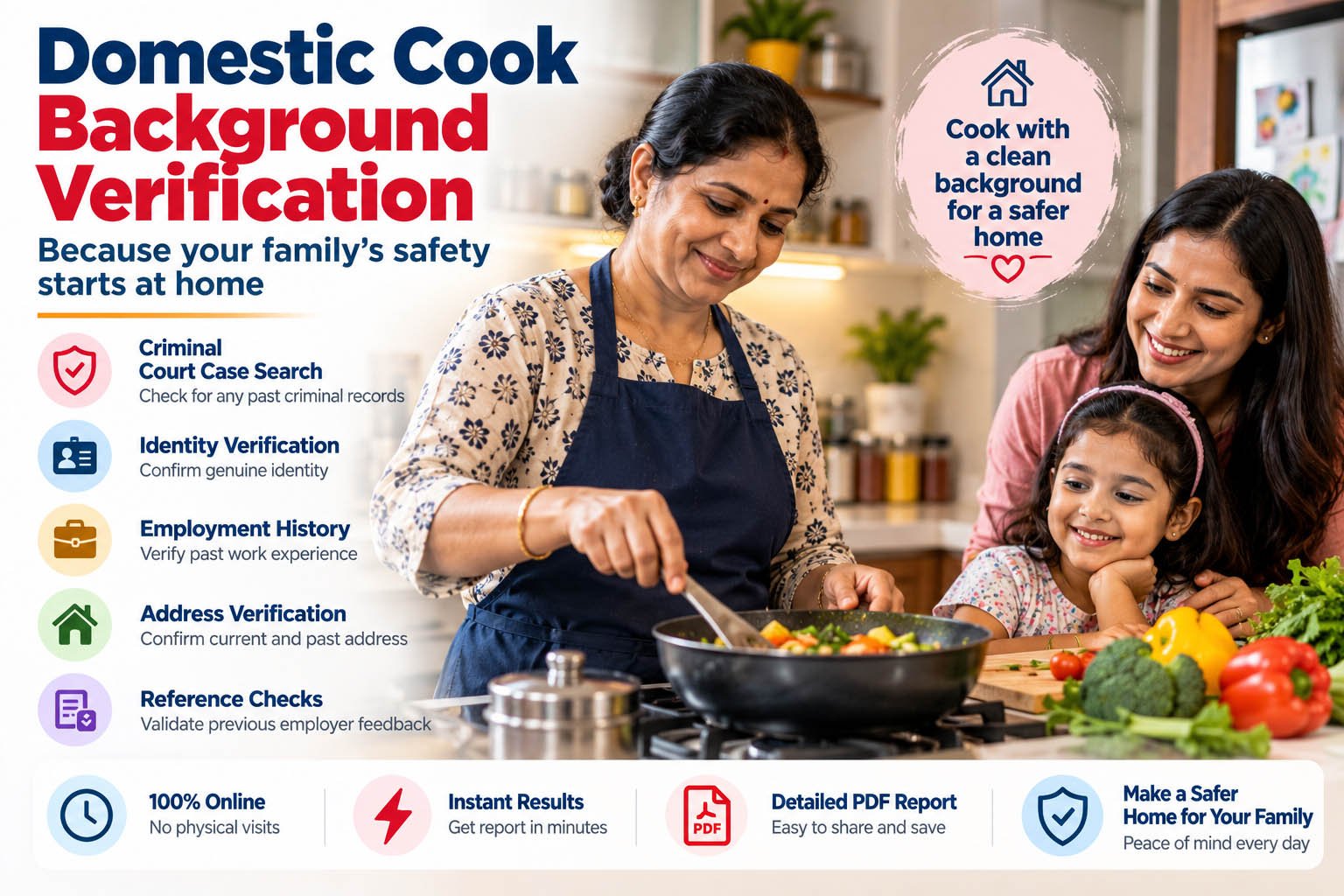
Cook Background Verification
Your maid may have been recommended by a neighbour. Your cook may have years of experience. Your driver may seem polite and trustworthy, and your children’s nanny may appear caring and responsible. But how much do you actually know about their identity, previous employment and background?
In India, millions of households depend on domestic workers to manage daily chores, care for children, support elderly family members, prepare meals and maintain their homes. These workers often receive access to private spaces, valuable possessions, family routines and, in many cases, children or vulnerable adults.
Yet, many households hire domestic staff based on verbal recommendations, convenience or a quick conversation, without verifying the person’s identity or checking relevant records.
Instant online background verification provides a practical way to make domestic staffing decisions more informed, consistent and responsible. By enabling households or their authorised representatives to initiate appropriate identity, criminal-record, address and reference checks online, it can reduce administrative effort and help identify warning signs before a person is entrusted with access to a home.
Background verification is not about treating every domestic worker as suspicious. It is about applying sensible precautions, protecting families, respecting workers’ rights and building trust on a stronger foundation than appearances alone.
Why domestic staff background verification matters in India
Unlike many conventional workplace arrangements, domestic employment often takes place inside a private residence, away from formal supervision. A domestic worker may have access to bedrooms, cupboards, keys, personal documents, jewellery, electronic devices and information about when family members are away.
Depending on the role, a worker may also spend hours alone with young children, elderly parents or people who need medical assistance.
This makes domestic staffing a particularly important area for responsible recruitment.
Consider the range of people who may enter your home:
-
Maid or domestic helper: Cleans rooms, washes utensils, does laundry and may access most areas of the house.
-
Cook: Handles food, enters the kitchen and may work while family members are absent.
-
Cleaner: May visit daily or weekly and gain access to rooms, appliances and household belongings.
-
Nanny or babysitter: May be entrusted with children for extended periods.
-
Elderly-care attendant or home nurse: May assist vulnerable family members with personal care, mobility or medication routines.
-
Driver: May transport family members, children and elderly relatives, sometimes independently.
-
Security guard: May monitor visitors, manage keys and learn household schedules.
-
Gardener, handyman or maintenance worker: May have access to the property, storage areas and household equipment.
-
Temporary replacement or agency-supplied worker: May enter the home with little prior familiarity or direct contact with the employer.
The appropriate background checks differ by role. A driver may need driving-licence verification, while a nurse may require confirmation of professional credentials. For domestic helpers, identity verification, relevant criminal-record checks and references from previous employers may be appropriate.
The fundamental principle is that anyone who regularly enters your home or has unsupervised access to family members should be considered for proportionate, role-appropriate verification.
What can go wrong when household staff are hired without verification?
Most domestic workers are honest people who perform essential work and deserve respect. Nevertheless, no occupation or personal recommendation can guarantee that every individual is suitable for every household.
Failing to verify basic information can leave families exposed to avoidable risks.
1. Theft of cash, jewellery and valuables
Domestic workers may be entrusted with access to rooms and household possessions. If theft occurs, the family may find it difficult to establish who had access, especially when multiple workers or visitors enter the property.
Identity verification and relevant checks may help establish who has been hired and identify certain warning signs. Reference checks may also reveal concerns raised by previous employers, provided those references are genuine and relevant.
However, background verification cannot guarantee that theft will not occur. Secure storage, access controls, inventory practices and fair employment procedures remain important.
2. Child safety and the risk of abuse
Parents may leave their children with nannies, babysitters or domestic helpers while working or travelling. A child may be unable to recognise inappropriate conduct, explain what happened or seek help.
This makes it important to verify identity, check references, review relevant and lawfully accessible records, and assess a caregiver’s experience and suitability.
A clean verification report does not prove that a person is safe in every circumstance. Families should also establish clear rules, supervise caregiving arrangements appropriately and ensure children know how to communicate concerns.
3. Elderly people and vulnerable family members
Older adults and people with disabilities may depend on caregivers for mobility, meals, hygiene and everyday activities. Misconduct can be particularly difficult to detect when the person receiving care has communication or memory difficulties.
Where a home nurse or healthcare professional is involved, households should verify relevant qualifications and professional registration in addition to identity and appropriate background checks.
4. False identities and misleading employment histories
A person may provide an inaccurate name, unverified address, fabricated employment history or misleading qualifications. An informal recommendation alone does not establish that these details are correct.
Identity verification and reference checks can help identify inconsistencies before the household makes a hiring decision.
5. Unauthorised access and misuse of household information
Domestic staff may learn when family members leave home, where valuables are stored, which entrances are used and when the property is empty. They may also encounter private documents, passwords written down or information about family travel.
Screening can contribute to a safer hiring process, but confidentiality rules, secure key management and careful handling of personal information are also necessary.
Recent Indian news reports: lessons for household safety
News reports involving domestic workers, caregivers and people entering private residences illustrate why families should take recruitment and access controls seriously. The cases below are examples of reported incidents, not proof that background verification would necessarily have prevented them. Where a report describes allegations or an arrest, it should not be interpreted as a final finding of guilt.
1. Jaipur: Domestic workers allegedly used a false identity — March 2025
A report published by The Times of India on 4 March 2025 described a robbery and assault in Jaipur involving two domestic workers who, according to police, had been hired without background checks. Investigators reportedly found that one worker had used a false name and that the family had not verified his identity.
What families can learn: A recommendation and a phone number are not substitutes for identity verification. Collecting relevant identity details, checking that the person presenting them is the same individual, and documenting the employment arrangement can make it easier to establish who has been given access to a home.
An online process can make these steps more convenient, although any mismatch still needs appropriate investigation.
2. Ludhiana: Domestic help allegedly stole cash and jewellery — July 2024
Hindustan Times reported on 6 July 2024 that a domestic worker who had been employed for approximately 15 days allegedly left a Ludhiana home with ₹3 lakh and jewellery while the family was away. The family had reportedly hired the worker on another domestic worker’s recommendation without police verification. An FIR was registered.
What families can learn: The first few weeks of employment are not too early for verification; they are precisely when it should already have been completed. A household should not have to wait until something goes wrong to establish an employee’s identity.
3. Delhi: A domestic worker accused in a serious assault and murder case — April 2026
In April 2026, The Indian Express reported that a 22-year-old woman, the daughter of an Indian Revenue Service officer, had allegedly been sexually assaulted and killed at her family’s home in southeast Delhi. Police arrested a former domestic worker who had recently been dismissed. The report stated that the worker had not allegedly undergone police verification.
A subsequent India Today report, published in July 2026, described a police chargesheet alleging that the accused had used his knowledge of a spare key to enter the residence. The case was proceeding through the criminal justice system.
What families can learn: Verification, careful offboarding and access control must work together. When a domestic worker leaves a job, keys should be recovered, access arrangements reviewed and any legitimate safety concerns documented. Background checks may help identify relevant prior information, but they cannot predict every future act or guarantee that an incident will not occur.
4. Kolkata: Police recommended mandatory verification of household employees — February 2026
A Hindustan Times report dated 8 February 2026 said Kolkata Police had recommended mandatory verification of household employees through its digital registration system. According to figures attributed to police, 32 of 104 thefts reported in the city during December 2025 and January 2026 involved maids, servants or caregivers. The report also described a serious case involving the alleged murder of an elderly woman by a former caregiver.
These figures were attributed to internal police statistics and should not be treated as a national crime rate.
What families can learn: Verification is especially important when elderly people live alone or depend on caregivers. Digital registration can also help families and authorities maintain usable records, rather than relying on informal arrangements that leave little documentation.
5. Panchkula: Cook arrested in a jewellery theft investigation — June 2026
The Tribune reported on 23 June 2026 that police had arrested a cook in connection with an alleged theft of gold and diamond jewellery worth approximately ₹40 lakh from the home of a 91-year-old woman in Panchkula. Police reportedly recovered the jewellery during the investigation and appealed to residents to verify domestic workers before employing them.
What families can learn: Even a worker who visits only to cook meals may enter the home regularly and have access to household spaces. Verification should be based on access and responsibilities, not simply on whether a worker lives in the home or works full-time.
The wider lesson from these reports
The incidents do not mean that domestic workers as a group should be distrusted. They demonstrate the importance of consistent, fair hiring practices and appropriate safeguards.
In several reports, a lack of verification was specifically identified as a concern. A reliable screening process might have exposed an identity discrepancy or relevant prior record if the information was available. It cannot establish that a crime would definitely have been prevented.
The practical lesson is clear: verify first, grant access responsibly, and maintain sensible safeguards throughout the employment relationship.
What does online background verification of domestic staff include?
A suitable verification service can help households or authorised representatives conduct checks appropriate to the worker’s role.
| Verification type | Why it matters |
|---|---|
| Identity verification | Helps confirm that the person is who they claim to be. |
| Address verification | Helps establish a documented address, subject to the available verification method. |
| Criminal-record checks | May identify relevant records in the sources searched. |
| Court-record searches | Can identify potentially relevant cases requiring careful review and identity matching. |
| Previous employment and references | May reveal discrepancies or relevant concerns from earlier work. |
| Driving licence verification | Relevant when hiring a personal or school driver. |
| Professional qualification checks | Relevant for home nurses and other regulated professionals. |
The checks available will depend on the provider, the source records, the worker’s consent or other applicable legal basis, and local requirements.
Importantly, a criminal case appearing in a search does not automatically establish guilt. Records must be matched to the correct person, their status understood and the findings reviewed fairly.
Why instant online background verification is better for Indian households
Traditional police verification may require completing forms, collecting documents, visiting a police station or waiting for the relevant authority to process an application. Procedures and timelines vary across cities.
An online verification service can simplify the initial steps and help families organise information without having to manage every administrative task manually.
1. Saves time when hiring domestic help
Domestic staffing decisions are often urgent. A family may need a replacement maid, a cook before a busy working week, or a caregiver when an elderly parent returns home from hospital.
Online verification can allow a family to submit information, initiate available checks and track the status through a digital workflow.
Instead of repeatedly calling agencies or managing paper records, the household can monitor what has been checked and what remains outstanding.
Some checks may return results quickly, while police verification, employer references and official record confirmation may take longer. Instant online access should mean convenient initiation and faster processing where possible, not a guarantee that every check finishes instantly.
2. Reduces administrative costs
Families who hire directly may avoid agency fees, but they often take on the responsibility of collecting information, contacting references and arranging verification themselves.
A digital service can reduce repetitive work, make information easier to organise and allow multiple checks to be initiated through one workflow.
The total cost should be compared with the service’s actual coverage and quality. A low-cost name search that cannot reliably distinguish between people with similar names may provide little practical protection.
Households should look for transparent pricing, clear explanations of what is checked, and an understandable report.
3. Improves accuracy when supported by reliable sources
A person’s name, mobile number or identity document alone does not prove that every detail is accurate.
A properly designed verification process can compare supplied information against available records, flag discrepancies and help identify potential identity mismatches.
For example, a worker may provide an address that differs from a previous employment record, or a reference may be unable to confirm the employment history described by the candidate.
These discrepancies should be investigated fairly rather than automatically treated as evidence of wrongdoing.
Online verification is only as reliable as its underlying data, identity-matching procedures and quality controls. Criminal-record databases may be incomplete, records may be outdated, and a search may return information relating to another person.
A trustworthy service should explain its source coverage and limitations instead of presenting every result as conclusive.
4. Makes verification more practical for everyday hiring
Families may employ several workers over time, including a maid, cook, driver, cleaner and caregiver. Some may work only a few hours a week.
A digital process makes it easier to apply the same basic hiring policy to each person, rather than checking only workers who are employed full-time.
It can also help households maintain records of when checks were requested and whether any follow-up is required.
This is particularly useful for families living in apartment complexes, gated communities or cities where workers may be supplied by agencies or referred through other employees.
5. Supports consent-based and transparent screening
Responsible background verification should protect the rights of domestic workers as well as the security of employers.
Before initiating checks, the household or service provider should explain what information is being collected, why it is needed and how the results will be used.
Where consent is the applicable legal basis, it should be obtained and documented appropriately. The process should not be used as an excuse to conduct unrelated searches or collect excessive personal information.
Digital workflows can make this process easier to document and manage, but technology alone does not ensure legal compliance.
Consent-based background verification: protecting both employers and workers
Domestic workers deserve dignity, privacy and fair treatment. They should not be presumed dishonest because they work inside another person’s home.
A responsible verification process should include:
-
Transparency: Explain the checks, their purpose and the information required.
-
Appropriate authorisation: Obtain consent where required or establish another lawful basis where applicable.
-
Data minimisation: Collect only information relevant to the stated purpose.
-
Secure handling: Restrict access to authorised people and protect sensitive documents.
-
Fair assessment: Allow a worker to explain discrepancies or challenge inaccurate information.
-
Responsible retention: Keep records only for appropriate periods, consistent with applicable requirements.
India’s Digital Personal Data Protection Act, 2023, and the Digital Personal Data Protection Rules, 2025 form part of the country’s framework for processing digital personal data. The applicable commencement provisions and legal requirements should be checked for the particular verification arrangement.
Consent is not a blanket authorisation for every possible search, and it does not eliminate other legal obligations. Similarly, households should not share a worker’s verification report publicly or circulate it unnecessarily in residential WhatsApp groups.
The aim is to build trust through a fair, documented process—not to stigmatise workers or expose their personal information.
How to verify domestic staff before allowing them into your home
A straightforward household verification policy can make the process easier to follow.
-
Collect the necessary details. Record the worker’s name, contact information, relevant identity details and employment arrangement.
-
Explain the process. Tell the worker what checks are proposed and obtain appropriate consent or other legal authorisation.
-
Initiate suitable checks on our website / app.
-
Review the results carefully. Resolve mismatches, distinguish allegations from convictions and give the worker a fair opportunity to clarify inaccurate information. Remember, ongoing court case is not a conviction.
-
Maintain appropriate records. Store the verification outcome securely and limit access to people who need it.
-
Maintain home-safety practices. Secure valuables, manage keys, establish visitor rules and use appropriate supervision for children and vulnerable adults.
Is police verification mandatory for domestic workers in India?
Requirements can vary by city and state. Some police commissioners issue local orders requiring residents to verify domestic workers, tenants or other categories of people. Households should check the latest applicable directions with their local police authority.
An online criminal-record search is not necessarily equivalent to formal police verification. Where an official police verification certificate or registration is required, a private digital report should not be assumed to replace it.
Frequently asked questions
Is online background verification of maids and cooks necessary?
It is a sensible precaution for households that employ people with access to their property or family members. Appropriate checks can help confirm identity, review relevant records and establish references before employment begins.
Can background verification prevent theft or assault?
It may help identify certain warning signs, including relevant prior records or identity discrepancies, when that information is available. It cannot guarantee that a crime will be prevented, and it should be combined with appropriate home-safety measures.
Can I verify a domestic worker’s criminal record online in India?
Yes, our background report lists lawfully accessible criminal or court records. For formal police verification, use the relevant official channel.
Should I verify a maid who has been recommended by another maid?
Yes. A recommendation can be useful, but it is not a substitute for verifying identity and conducting appropriate checks. The same principle applies to referrals from neighbours, relatives, residential associations and domestic staffing agencies.
Is instant background verification always accurate?
Results depend on source quality, data completeness, identity matching and how the findings are interpreted. A potential match should be reviewed before it is treated as a finding about a particular individual.
Does background verification invade a worker’s privacy?
It should not when conducted appropriately and lawfully. The process should be consent based, transparent, limited to relevant checks, properly authorised and designed to protect personal information.
Should I verify a domestic worker who comes only once a week?
Consider the person’s access to the property, the nature of the work and the applicable requirements. Regular or occasional access can still create a need for proportionate safeguards, particularly when a worker is left unsupervised inside the home.
Conclusion: make verification part of responsible household hiring
Hiring domestic staff is an important decision because it involves more than completing household chores. It involves giving another person access to your home, possessions, daily routines and, in many cases, family members who depend on you for protection.
Recent incidents reported in Jaipur, Ludhiana, Delhi, Kolkata and Panchkula demonstrate why households should not rely entirely on recommendations or personal impressions. In some cases, the absence of verification was specifically highlighted by police or reported as a concern. These cases do not prove that a background check would have prevented every incident, but they reinforce the value of responsible hiring and documented identity checks.
Instant online background verification can make the process more convenient, reduce administrative effort, support more consistent checks and improve access to available information. Its value depends on reliable sources, appropriate authorisation, careful review and respect for workers’ privacy.
The most effective approach combines verification before employment with secure home-access practices, fair treatment, clear expectations and appropriate supervision.